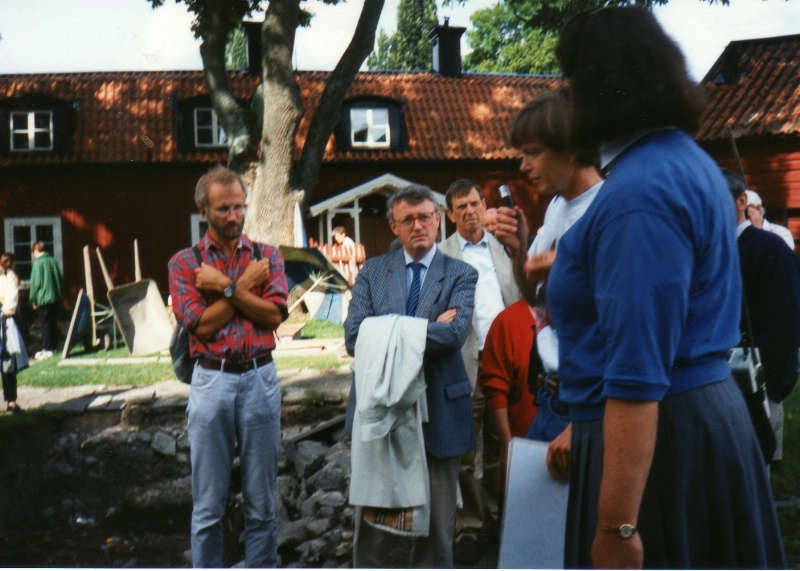
Date: 28 August – 2 September.
Themes: Developments Around the Baltic Sea in the Viking Age; Urbanization in East and West; Means of Bayments in East and West and Descriptions of society in eraly litterature.
Patron: H.M. King Carl XVI Gustav.
Organising Committee:
Prof. Lennar Elmevik (Nordic languages) of Uppsala, Prof. Brita Malmer, later replaced by prof. Kenneth Jonsson (Numismatics) of Stockholm, Departmental director Helmer Gustavson (runology) of Stockholm and Björn Ambrosiani (archaeology) both of RAÄ-SHMM in Stockholm. Marit Åhlén was appointed secretary and practical organizer.
National Representatives:
- Denmark: Hans Bekker-Nielsen, Gillian Fellows-Jensen, Claus Feveile, Jörgen Höjgaard Jörgensen, Bente Holmberg, Niels Lund, Preben Meulengracht Sörensen, Anne Pedersen, Else Roesdahl, Jörgen Steen Jensen, Marie Stocklund.
- Faroe Islands: Arne Thorsteinsson
- Iceland: Guðmundur Ólafsson
- Ireland: Uaininn O’Meadhra, Patrick Wallace.
- Norway: Jan Ragnar Hagland, Knut Helle, Signe Horn Fuglesang.
- Sweden: Björn Ambrosiani, Helmer Gustavson
- United Kingdom: Paul Buckland, Helen Clarke, Christine Fell, James Graham-Campell, Richard Hall, Judith Jesch, Michael Metcalf, David Parsons.
Delegates of the Congress:
Denmark: Hans Bekker-Nielsen Gillian Fellows-Jensen Claus Feveile, Bente Holmberg, Niels Lund, Preben Meulengracht Sørensen, Anne Pedersen, Else Roesdahl, Marie Stoklund.
England: Paul Buckland, HelenClarke, Christine Fell, James Graham-Campbell, Richard Hall, Judith Jesch, Michael Metcalf, David Parsons.
Faroe Islands:Arne Thorsteinsson
Iceland: Guðmundur Ólafsson
Ireland: Uaininn O’Meadhra, Patrick Wallace.
Norway: Jan Ragnar Hagland, Knut Helle, Signe Horn Fuglesang, Heid Gjøstein Resi, Sigrid Kaland, Irmelin Martens, Else Mundal , Kolbjørn Skaare, Anne Stalsberg, Gro Steinsland, Per Sveaas Andersen, Birthe Weber.
Scotland: Colleen Batey, Ian Fisher, Christopher Morris, Olwyn Owen.
Sweden: Björn Ambrosiani Birgit Arrhenius, Stefan Brink, Johan Callmer, Lennart Elmevik, Anne-Sofie Gräslund, Helmer Gustavson, Anders Hultgård, Ingmar Jansson, Kenneth Jonsson, Brita Malmer, Lena Peterson, Karl Inge Sandred, Kenneth Svensson, Sten Tesch, Inger Zachrisson, Marit Åhlén.
USA: Thomas Noonan.
Excursions:
Birka, Sigtuna, Uppsala, Gamla Uppsala, Hippinge and Granby in Orkesta, Markim Orkesta, Nordians hög, Åshusby in Norrsunda.
Sponsors:
Kungl. Gustavs Akademien, Kungliga Vitterhets Historie og Antikvitets Akademien, Riksantikvarieämbetet and Statens Historiska Museer, And the Gunnar Ekström Foundation.
Notes:
Gösta Berg 1903-1993 by Helmer Gustavson
The library is a splendid meeting place, and has much to offer. I did not meet Gösta Berg very often and it was at the Viking Congresses, at some other symposia and in a few other places that he recounted to me the folk culture of Upper Dalarna. This was very valuable for someone interested in the runes of the Upper Siljan area. There were only a few times when I met him in the library but at the same time I can say that I did meet him often in the library. Namely, he was an incredibly industrious scholar and reviewer, and his reviews, particularly in Rig, made it possible for those outside his specific discipline to follow the scholarly debates within his area of activity. His reviews were a type of friendly but brief conversation with the authors; for example, he pointed out the results which other researchers had come to and which could complement the problems under discussion and the explanations given.
This is not the place to express Gösta Berg’s importance in Swedish cultural life. He himself was almost part of an epoch, together with scholars such as Sigurd Erixon, Sigfrid Svensson and others. This is well known to all.
Thus, Gösta Berg was a giant in many ways – I am in fact thinking of some group photographs in earlier Viking Congresses! I can understand that through his intellectual and bodily characteristics he came to take a prominent place in these meetings. He took part in the Viking Congresses from their beginning in 1950 and only missed the meeting in Århus in 1977. He described the themes and delegates of the various Congresses in an article in Fornvännen in 1988.
Gösta Berg was one of the last giants of learning: one of those who carried an encyclopaediac knowledge which our present society does not breed. But he carried his scholarship without affectation and with generosity. A well-thumbed but unpretentious book which I often consult in the second edition of 1969 is his Svensk bondekultur. This was co-authored with another giant of learning, Sigfrid Svensson. For me this book is in some ways a reincarnation of Gösta Berg and all his best sides as scholar and popularizer.
Many of the participants in the Viking Congress are acquainted with his great and good characteristics as a human being. He will remain in our memories with joy.
Robert B K Stevenson 1913-1992 by Christopher D Morris
Robert Stevenson was not a regular member of the Viking Congresses, but a welcome one when he did attend, for instance in the Faroes and Isle of Man. He was the senior Scottish member when on ‘home territory’ in 1989 in Caithness and Orkney and his informal contributions there were perceptive and based upon long acquaintance and a lifetime of scholarship. In the Fifth Congress Proceedings, he published the preliminary account of ‘The Brooch from Westness, Orkney’, thereby drawing the attention of members to the remarkable finds made in 1963, and since followed up by extensive excavations under the direction of Sigrid Kaland of Bergen University with her international teams, now also reported on in the Eleventh Congress Proceedings. The final, typically meticulous, publication came in 1989 (the delay was not of Robert’s making).
Robert was always encouraging of international cooperation, and his breadth of knowledge and expertise was wide indeed. From the Stone Age to the ‘Forty-five was the title of the Festscrift presented to him, and the title indicates his wide interests in the Scottish past. As for his period of specialism – the Early Medieval – his mastery of the complexity of metalwork and sculpture studies was second to none, and demonstrated his wider international interests.
Robert Stevenson was born in Glasgow in 1913 and studied at Edinburgh, Bonn and the Institute of Archaeology in London. He was a fieldworker in earlier years, working in places as diverse as Maiden Castle, Istanbul and Scottish hill-forts. He maintained his interest in the fieldwork aspect of the discipline, even when well-established in the National Museum of Antiquities in Edinburgh. I remember many perspective questions regarding my own work at Deerness and Birsay (to which he has contributed significant specialist studies), and he was always interested in new discoveries – for instance during the Eleventh Congress.
Perhaps what was most striking about Robert was his encouragement of others – whatever their age or status. He was as courteous with a young postgraduate as with a senior scholar, and his friends in archaeology crossed several generations. His academic standing has been recognised far and wide. My own personal sadness is that, although he was born literally next door to the present home of the Department of Archaeology in Glasgow University (the son of the Professor of Hebrew and Semitic Languages), he died before procedures could be put in train to award him an Honorary Degree. However, his achievement in several fields — including Viking Age Archaeology — will last on and be a fitting memorial in itself.
Professor Tom Fanning 1933-1993 by Patrick Wallace
Tom Fanning was an expert on the archaeology of Ireland during the Viking Period, particularly the ringed pins, with the study and distribution of which his name became synonymous. With typical commitment and character he courageously insisted on correcting on his death bed the proofs of his definitive study of the Dublin ringed pins which will be published in the joint National Museum of Ireland/Royal Irish Academy series of reports on the Dublin excavations on the first anniversary of his death, in July 1994.
Although his study of the pins brought him all over the modern Viking world, his background, experience and achievements were much wider. He was a teacher who became a full-time archaeologist in 1970 when he was appointed an Assistant Inspector in the National Monuments Branch of the Office of Public Works. While there, he undertook large scale excavations at early medieval and later sites like Clontuskert, Co. Galway, Reask, Co. Kerry, Kells, Co. Kilkenny and Swords, Co. Dublin. Discoveries at the latter led to his collaboration with Elizabeth Eames on a corpus of Irish medieval floor tiles which they published as a monograph. His Clontuskert and Reask reports were also published and they typify the thoroughness and maturity of his approach.
Tom also directed the national archaeological survey for the Office of Public Works and was instrumental in setting up and later getting published surveys of the field monuments of Co. Donegal and the Dingle Peninsula of Co. Kerry. He moved on to the archaeology department of University College Galway as a lecturer and was made associate professor there shortly before his untimely death.
Tom Fanning was a great supporter of the Viking Congresses. He was a member of the Isle of Man, Larkollen and Orkney/Caithness conferences and had a paper on ‘The Hiberno-Norse pins from the Isle of Man’ in the Manx Congress proceedings (1983, 27—36). He had been looking forward to the Stockholm Congress for which he was already booked. Sadly he was not to make it.
Tom was a good and kind friend to us all. He is a terrible loss to Viking Age studies in Ireland and to his university. He will be missed in many places at home as across the Viking world where nobody could sing better at gatherings of archaeologists. The sympathy of the members of the Twelfth Viking Congress go to his wife Terry and their daughters who hopefully will find some consolation from his contribution to his beloved subject and from the regard and affection in which he was held outside of Ireland. Ar dheis de go raibh a anam macánta dílis.
Torben Kisbye 1930-1990 by Gillian Fellows-Jensen
Torben Kisbye died on the 27th April 1990 at the age of 60. For many years he had lectured in English at the University of Århus and had introduced several generations of students there to the results of Viking influence on the English language. One of the fruits of his teaching was his useful textbook from 1982 Vikingerne i England — sproglige spor. His doctoral dissertation from 1988 dealt with linguistic influence going in the reverse direction, being a collection of essays entitled Engelsk påvirkning af dansk personnavneskik gennem 1000 år. The main emphasis of these perceptive and elegantly written studies is on English names in Denmark in more modern periods but they include an erudite study of name-forms on the Danish coinage of Knut the Great.
Perhaps the main contribution made by Torben Kisbye to Viking studies, however, was his cooperation with Else Roesdahl in organising the interdisciplinary Viking symposia in Århus. He was a founder member of the group of scholars from Odense, Århus and Copenhagen who initiated these annual meetings and at the first symposium in Odense in 1982 he read a paper on the Danelaw. He was a splendid host, an entertaining companion and a kind friend and he is sadly missed by all his colleagues in Denmark and abroad. He died playing water-polo, a fitting end for a true Viking who would not have wished to die a straw-death.
They all live on in their writings and in the annals of the Viking Congress!
Congress Diary:
By Björn Ambrosiani
The Eleventh Viking Congress in Caithness and on Orkney in 1989 presented the opportunity of inviting the next meeting to Sweden; it was a suitable occasion as it was 20 years since Sweden had had the benefit of hosting the Congress, and as 1990 would see the beginning of excavations at Birka, one of the key sites for Viking Age research.
The invitation was accepted and an Organising committee set up. This comprised Professor Lennart Elmevik (Nordic languages) of Uppsala, Professor Brita Malmer, later replaced by Professor Kenneth Jonsson (numismatics) of Stockholm, Departmental director Helmer Gustavson (runology) and Docent Björn Ambrosiani (archaeology), both of RAÄ-SHMM in Stockholm. Marit Åhlén of RAA was appointed secretary and practical organizer.
The Congress received financial support through generous donations from Kungl. Gustav Adolfs Akademien, Kungl. Vitterhets Historie och Antikvitets Akademien, Riksantikvarieämbetet and Statens Historiska Museer, and the Gunnar Ekström Foundation. His Majesty King Carl XVI Gustaf agreed to be the Patron of the Congress.
Thus, about 70 Viking Age scholars from various disciplines gathered at Hässelby Slott outside Stockholm at the end of August and beginning of September 1993. A number of scholars from the two host academies and the museums in Stockholm also took part.
The meeting was arranged as a number of day-long thematic discussions on the main theme of the meeting, Developments around the Baltic and the North Sea in the Viking Age. Each day ended with some shorter contributions and progress reports within the research field. There were excursions to Birka and elsewhere in the Stockholm region. Some of the delegates ended the meeting with a longer excursion to Gotland.
On the first day the delegates heard a number of appreciations of some long-standing members of the Viking Congress who had died since the previous meeting. [see above]
Programme and discussions
The first day, 28 August, was devoted to the theme Urbanization in East and West. The keynote speakers were Johan Callmer and Richard Hall. The subsequent discussion under the chairmanship of Björn Ambrosiani dealt mainly with previously unknown sites and mints, why so many Viking Age nucleated settlements had been abandoned and replaced by other sites, the difference between ‘centres’ and ‘urban sites’, plot divisions etc.
Two days of excursions intervened, and then there was a second day of lectures on the theme Means of Payment in East and West – numismatics, economy, trade. The keynote speakers were Michael Metcalf and Thomas Noonan. The discussion was chaired by Niels Lund and concentrated on the possible minting of coins in Ribe and its background, and also the relationships between various regions of Scandinavia with regard to coin distribution.
The third day of lectures was devoted to linguistic questions and introduced by Knut Helle’s keynote lecture Descriptions of society in early literature. The subsequent discussion, chaired by Christine Fell, concentrated particularly on the definition civitas. There was further discussion about what a site might consist of, if its central functions may have extended to many sites in its vicinity, about the reliability of early written sources etc.
The remainder of this day was chaired and introduced by Lennart Elmevik and included a number of shorter presentations on linguistic subjects.
Other short Communications on recent finds and research topics were given during the days of excursions and lectures. Their titles and texts appear in this publication.
Excursions
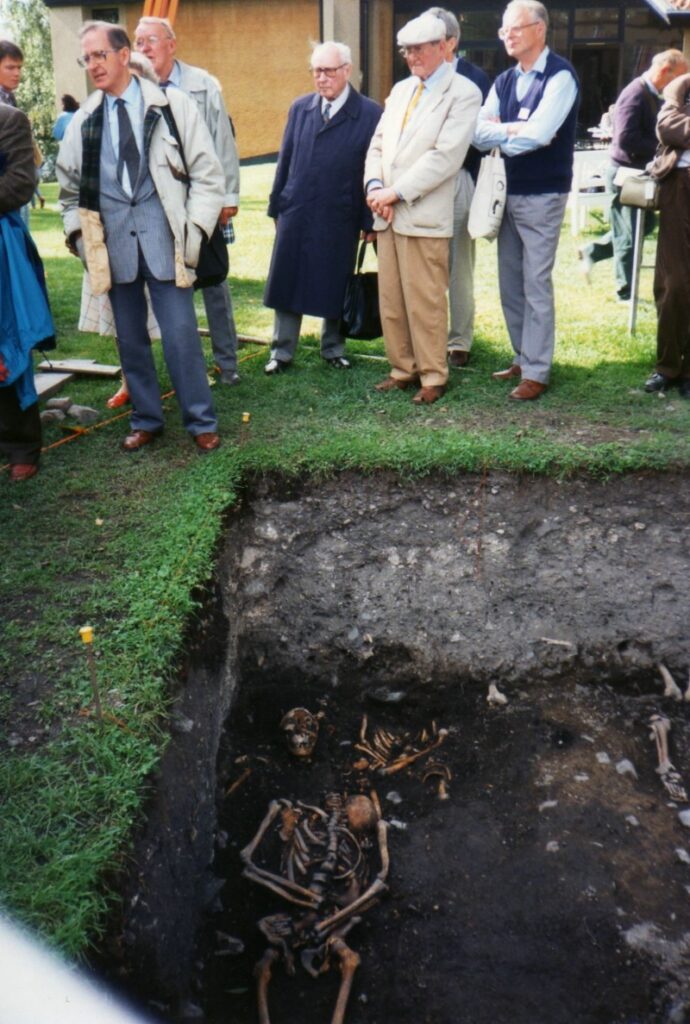
On Sunday 29 August the Congress visited Sigtuna and Uppsala. A tour of the town of Sigtuna, its new museum and current excavations was conducted by Sten Tesch and his assistants. The newly discovered bishop’s grave containing a crozier and lying within the museum’s garden attracted much interest.
A session of short presentations was succeeded by lunch and then the excursion continued to Uppsala where the Kungl. Gustav Adolfs Akademien provided a reception for the Congress, presided over by the Vice-president of the Academy, Carl-Göran Andrae.
Gamla Uppsala was visited in the evening. Wladyslaw Duczko demonstrated the current excavations on the terraces of the royal manor. Large post-holes suggested that there had been a great hall there, radio-carbon dated to the Vendel period.
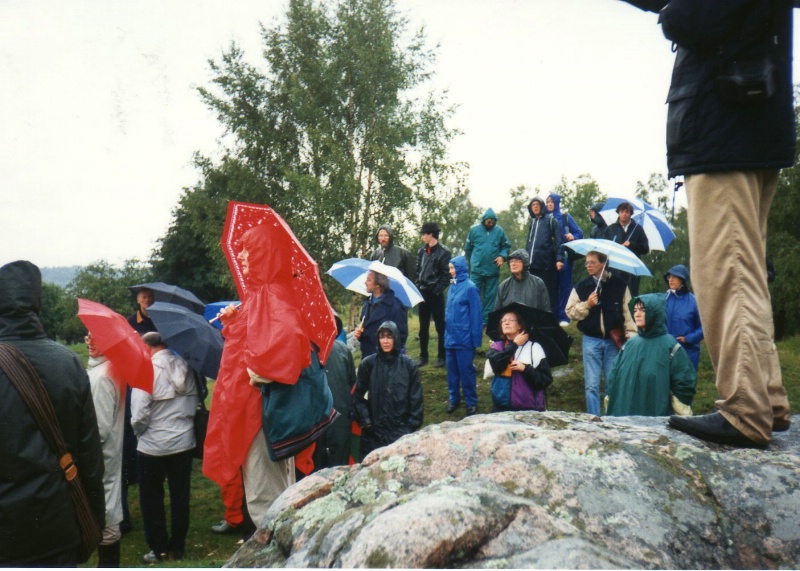
On the next day the Congress went by boat to Birka where the Excavation Director Björn Ambrosiani led a group around the island and its cemeteries in more or less continuous rain.
At the end of the following day of lectures the Congress was invited to Historiska Museet, Stockholm, where Jan Peder Lamm was responsible for the reception and a visit to the current exhibition Den svenska historien. The gold room, still under construction, was also available to view.
The last day of the Congress, Thursday 2 September, was taken up by an excursion to eastern Uppland. The main purpose of the excursion was to visit ‘Thing’ sites and runic monuments beside roads, but the site ot Hyppinge and Granby in Orkesta with its interesting runic stone was also visited. The proposal to designate Markim-Orkesta a World Heritage Site was discussed. At Markim church, Stefan Brink talked about place-names in the Markim region. The excursion was ended by a brief visit to the biggest burial mound in Uppland, Nordians hög, beside the royal manor of Åshusby in Norrsunda parish. The delegates then dispersed, some by bus to Arlanda, others for the excursion to Gotland.
The Gotland excursion
Only thirteen Congress members took part in the Gotland excursion.
The first day was devoted to Visby, visiting Gotlands Fornsal and a tour of the town conducted by Landsantikvarien (County archaeologist) Sven Olof Lindquist. Lunch followed. The evening was concluded by a magnificent medieval banquet at the invitation of Visby urban council.
On Saturday there was a trip through Gotland, led by Dan Carlsson. He had put together a programme which included Viking Age and earlier monuments to give an overall depiction of the cultural landscape of the island.
The Thirteenth Congress
It was agreed, with acclamation, that the next Viking Congress should meet in Nottingham 1997, organized by Christine Fell. Excursions will be to York and Yorkshire.
Björn Ambrosiani
Stockholm, September 1994
Congress Proceedings:
The Twelfth Viking Congress. In Birka Studies. Volume 3. Ed. Björn Ambrosiani, Helen Clarke. Stockholm 1994.
Contents:
List of Illustrations p. 7
Acknowledgements p. 8
Foreword p. 9
1 The Twelfth Viking Congress. Introduction Björn Ambrosiani p. 11
PART I URBANIZATION AND SETTLEMENT IN EAST AND WEST p. 19
2 Descriptions of Nordic Towns and Town-like Settlements in Early Literature. Knut Helle p. 20
3 Vikings Gone West? R.A. Hall p. 32
4 Urbanization in Scandinavia and the Baltic Region c AD 700-1100: Trading Places, Centres and Early Urban Sites. Johan Callmer p. 50
5 The Latest News from Viking Age Ribe: Archaeological Excavations 1993. Claus Feveile p. 91
6 If the Vikings Knew a Leading – What Was It Like? Niels Lund p. 98
7 Dendrochronology and Viking Studies in Denmark, with a Note on the Beginning of the Viking Age. Else Roesdahl p. 106
8 Runes Stones – On Ornamentation and Chronology. Anne-Sofie Gräslund p. 117
9 Twig Layers, Floors and Middens. Recent Palaeoecological Research in the Western Settlement, Greenland. P.C. Buckland, T.H. McGovern, J.P. Sadler and P. Skidmore p. 132
10 The Viking and Early Settlement Archaeological Research Project: Past, Present and Future. Christopher D. Morris, James H. Barrett and Colleen E. Batey p. 144
11 Scar, Sanday: a Viking Boat-burial from Orkney. An Interim Report. Olwyn Owen and Magnar Dalland p. 159
12 Saamis and Scandinavians -Examples of Interaction. Inger Zachrisson p. 173
13 Norwegian Viking Age Weapons, some Questions Concerning their Production and Distribution. Irmelin Martens p. 180
14 The Russian-Norwegian Sword Project. Anne Stalsberg p. 183
15 Iron Age Combs: Analyses of Raw Material. Birthe Weber p. 190
Part 2 Means of Payment in East and West p. 195
16 The Beginnings of Coinage in the North Sea Coastlands: a Pirenne-like Hypothesis. D.M. Metcalf p. 196
17 The Vikings in the East: Coins and Commerce. Thomas S. Noonan p. 215
18 Do the Coin Finds of Recent Years Change Our Ideas About the Character of Monetary Circulation in Denmark in the Viking Age? Jørgen Steen Jensen p. 237
Part 3 The Nordic Languages as Borrowers and Lenders in the Viking Age and Early Middle Ages p. 243
19 Introduction. Lennart Elmevik p. 244
20 Cultural Progression: Latin and Runic Writing. Barbro Söderberg p. 247
21 From Scandinavia to the British Isles and Back Again. Linguistic Give-and-take in the Viking Period. Gillian Fellows-Jensen p. 253
22 Viking Administration in the Danelaw: a Look at Scandinavian and English Hundred-Names in Norfolk. Karl Inge Sandred p. 269
23 The Place-names of Markim-Orkesta. Stefan Brink. p. 277
24 Recent Research into Sacral Names. Bente Holmberg. p. 280
25 Ragnarok and Valhalla: Eschatological Beliefs among the Scandinavians of the Viking Period. Anders Hultgård. p. 288
26 Skaldic and Runic Vocabulary and the Viking Age: a Research Project. Judith Jesch p. 294
27 The Dublin Runes. Jan Ragnar Hagland p. 302
28 Scandinavian Runic-text Data Base: a Presentation. Lena Peterson p. 305
29 Sandwich: the Oldest Scandinavian Rune-stone in England? David Parsons p. 310