
Date: 7th – 21st July.
Themes: The impact of Norse culture upon Scotland and the Scottish Islands considered under different aspects: geographical, antiquarian, historical, social, economy and literary.
Patron: There was no Patron.
Organising Committee:
Dr. W. Douglas Simpson, University of Aberdeen; Mr. Andrew O’Dell, University of Aberdeen; Mr. A.C. Davis, British Council in Aberdeen.
National Representatives:
Denmark: Prof. Johannes Brøndsted, Prof. Christian Matras.
Iceland: Dr. Kristján Eldjárn, Prof. Einar Ólafur Sveinsson.
Ireland: Prof. S.P. Ó Ríordáin.
Sweden: Dr. Gösta Berg, Prof. Birger Nerman.
UnitedKingdom: R. L. S. Bruce-Mitford, Dr. W. Douglas Simpson.
It is not certain if national representatives actually existed from the start. They do not appear in the proceedings of the first Congress – but these are mentioned in the proceedings of the second one.
Delegates of the Congress:
Denmark: Dr. O. Widding, Jutland, compiler of Danish dialect and Old Norse Dictionaries; Dr. Christian Matras (Faroes), Lecturer in Faroese, Copenhagen University; Dr. Ragnar Knudsen, teacher, Risskov, Denmark, philologist, folklorist and historian.
England: Mr. E.O.G. Turville-Petre, M.A.,B.Litt., Reader in Ancient Icelandic, Oxford University; Professor A.S.C. Ross, Professor of English Language, Birmingham University.
Iceland: Professor Einar Ól. Sveinsson, Professor of Icelandic Literature in the University of Iceland, Reykjavík; Professor Jón Helgason, Professor of Icelandic in Copenhagen University.
Norway: Professor Haakon Shetelig, Historical Museum of Antiquities, Bergen, Norway, Dr. Per Thorsen, Bergen, secondary school teacher (modern languages), investigator of Scandinavian elements in English and Scots, Mr. Haakon Hamre, Lecturer in Old Norse, Bergen University (son-in-law of Professor Shetelig).
Ireland: Dr. J.H. Delargy, Director of the Irish Folklore Commission, University College, Dublin.
Scotland: Principal T.M. Taylor, Principal of Aberdeen University; Mrs. Taylor General Sir Ronald Adam, Chairman of the British Council; Dr. A.O. Curle , formerly Director of the National Museum of Antiquities of Scotland; Mr. T.M.Y. Manson, M.A., of the Local Committee. Mr. G.W. Russell of the Local Committee and former Town Clerk of Lerwick; Professor J.D. Mackie, Historiographer Royal of Scotland, and Professor of Scottish History and Literature, Glasgow University; Dr. A.B. Taylor, Assistant Secretary to the Department of Health for Scotland, recent translator of the Orkneyinga Saga; Mr. Stewart Cruden, Inspector of Ancient Monuments for Scotland, Ministry of Works; Mrs. Murison, wife of the Editor of the Scottish National Dictionary; Mr. George Scott Moncrieff, Scottish descriptive author; Dr. W.T.H. Williamson, Lecturer in Soil Science, Aberdeen University (native of Reawick, Shetland); Mr. A.C. Davis, M.A., Area Officer for the North of Scotland, the British Council, Aberdeen; professor Angus McIntosh, Professorof Linguistics, Edinburgh University; Mr. H. Harvey Wood, Representative for Scotland of the British Council, Edinburgh; Miss M. Macgregor, Matron, the Bruce Hostel; Mr. Gerrie, free-lance press photographer; Dr. E.F. Halvorsen (Norwegian), Lecturer in Norse, Glasgow University; Dr. W. Douglas Simpson, Librarian, Aberdeen University. Mr. E.S. Reid Tait, of the Local Committee, Shetland bibliographer and text editor; Professor Croft Dickinson, Fraser Professor of Scottish History and Palaeography, Edinburgh University; Mr. David Murison, Editor of the Scottish National Dictionary; Mr. A.O. O’Dell, Reader in Geography, Aberdeen University, and author of The Historical Geography of the Shetland Islands; Dr. F.T. Wainwright, Lecturer in Mediaeval History, University College, Dundee; Mr. R.W. Munro, representative of the Scotsman newspaper; Mr. John Stewart, teacher in Skene Square School, Aberdeen (native of Whalsay, Shetland).
Sweden: Professor Dag Strömbäck, of the Chair of Folk-Lore Research, Uppsala University, Sweden: Mrs. Strömbäck; Dr. Oscar Lundberg, retired Head of the Foreign Department of Uppsala; University Library, Sweden; Miss Asa Sjödin, Swedish folklorist, ethnologist and traveller
Dr. Gösta Berg, Director of the Nordic Museum, Stockholm; Mr. Erik Frykman, University of Uppsala, reappointed while in Lerwick to the post of Lecturer in Swedish at Aberdeen; University, which he held temporarily from 1946 to 1948.
Excursions:
Jarlshof, Scalloway, Eshaness, Broch of Clickhimin, Broch of Mousa, Stanydale, Kirkwall.
Sponsors:
The British Council
The University of Aberdeen, with the cooperation of the Universities of Hull, Leeds and Sheffield
County Council of Shetland
The Town Council of Lerwick.
Notes:
After a successful Congress it was unanimously decided that The Viking Congress should become a permanent institution with a certain number of delegates invited by national representatives or contact persons.
Congress Diary:
The idea of bringing together at Lerwick a representative team of British and Scandinavian scholars to discuss, in its broadest aspects, the whole question of the Norse occupation of the Scottish islands originated in the year 1946 in the mind of Mr. Robert Bruce, a graduate of Aberdeen University, who at that time was Area Officer in Aberdeen of the British Council. Early in 1948 Mr. Bruce was transferred to an overseas post and the project came to naught: but the idea of the Scoto-Scandinavian Conference, as it was at first called, was taken up afresh and vigorously pursued by his successor, Mr. A. C. Davis.
Early in this second stage the co-operation of the University of Aberdeen was sought by the British Council and very cordially given. As a result of their joint efforts, the Viking Congress duly took place in Lerwick from the 7th to the 21st of July, 1950. The title of the Congress was chosen by the distinguished Scottish author, Eric Linklater.The proposal to gather so large and distinguished a company at the remotest apex of the British Islands was certainly a bold one. It was not received with favour in all quarters. There were those who urged the impracticability of holding the Conference in the far northern town and who conceived that the only proper place for it was a metropolitan centre. Others again thought of the Congress purely as a gathering of museumists whose requirements would be satisfied by looking at exhibits through the panels of glass cases. The promoters of the Congress had a wider vision and a more vivid imagination than those of such doubters. They did not conceive of the Congress as a purely antiquarian gathering but as one of scholars drawn from broad fields of research who should consider the Norse occupation of the Islands and of large tracts of Northern Scotland in all its bearings: geographical, antiquarian, historical, social, economic, and literary. And they were determined that our Scandinavian guests should be shown something of the actual lands in which the Vikings settled. Their minds were fired by an eloquent passage in one of the books of the late Professor A. W. Brøgger―who, to the great regret of the Congress was prevented at the last moment by illness from attending―in which he described the feelings that allured those ancient wanderers from the Scandinavian countries to our Northern shores and islands:―
Why did not the Norwegian emigrants journey more to the south, to warmer countries and better conditions? Why did they content themselves with the Shetlands, Orkneys, and Hebrides, and why, at a later date, did they seek even harder conditions in the Faroes and Iceland?
The answer to this is easily found. Some of the emigrants of olden times actually did make their homes in southern lands, become freeholders both in England and France. In those cases, however, they came under other forms of law in countries where they lost their racial identity and disappeared swamped in an alien race. As a matter of fact, only a very small percentage chose this course. The choice of northerly regions by the majority was due to fundamental and primitive causes. It was the craving for surroundings where something of the old was to be found in their new activities. They asked for sea and fjord, mountain and hill, the fowling cliffs and sealing grounds. They needed the pastures, meadows, and heather, to which they had been accustomed in the land of their birth, and the light summer nights which brooded softly over farm and field at home in Norway. No sentimental spirit of homesickness lay at the back of all this, but the simple fact that the whole of their mentality, fostered by the toil of countless generations before them, was adjusted to a life in which all these things were to be found. All else would be in the nature of transplanting, obliteration, and sacrifice. It would deprive them of the powers which were their inheritance and their greatest asset.
In the organization of the Congress the division of responsibilities, broadly speaking, was that the British Council was concerned with the administrative side and the University with the academic side of the programme. From the moment that the project was first brought to their attention the County Council of Shetland and the Town Council of Lerwick threw themselves into the arrangements with the utmost possible zeal, co-operation and generosity.
The County Council placed at the Congress’s disposal the splendid Bruce Hostel where the members were quartered together in the greatest comfort, and provided free transport for all the land excursions. The Town Council, in addition to entertaining the Congress to lunch on their arrival and giving a civic reception for them, also provided an admirable concert illustrating Shetland folk culture, including the famous Papa Stour Sword Dance, by a team brought over from the islands. The Town Council placed at the Congress’s disposal the Garrison Theatre for those lectures where a lantern was necessary and their very handsome Town Hall for the other sessions of the Congress. To the Town and County Councils, to Mr. W. Thomson, the Convener of the County, and to two successive Provosts of Lerwick―Mr. J. Aitken, who was in the civic chair when the initial arrangements were made, and his successor, Mr. R. A. Anderson― the warm thanks of the British Council and the University of Aberdeen are due.
In a short introductory summary such as this it is obviously quite impossible to acknowledge by name the indebtedness of the Congress to all those in Shetland who laboured with might and main to make it a success and of whose enthusiasm, helpfulness, and abounding hospitality, the members of the Congress will retain an indelible impression. It would, however, be a gross omission not to mention the outstanding assistance rendered to the Congress, from the moment when the project was first mooted, by Mr. T. M. Y. Manson, editor of the Shetland News. His great services to the Congress and his outstanding qualifications as an authority on the historical aspects of the Norse Earldom of the Isles have since been fitly recognized by the University, which, in 1951, conferred upon him the Honorary Degree of Doctor of Laws.
This Introductory Note is followed by a daily record of the sessions of the Congress as they actually took place. Certain small alterations were inevitable in the programme as drafted beforehand and contained in the Congress Handbook. In the body of the present volume will be found summaries at greater or lesser length of the principal papers delivered. It should be stated that Dr. Linklater’s address on the Battle of Clontarf, delivered to the most crowded session of the Congress, has been published by him separately.
All the meetings of the Congress were open to the public and all present were invited freely to join in the discussions that followed the readings of the various papers. One of the things that most pleased the visiting members of the Congress was the revelation that there exists in Shetland a body of scholarly men and women who were able to take part on an equal footing with their learned guests in discussions and arguments ranging over abstruse questions of archaeology, history, Norse and Scottish law, economics, philology, literature and folklore.
The University of Aberdeen and the Shetland County Library combined in making available to the members of the Congress, in the Bruce Hostel, an extensive collection of books dealing with the subjects of the sessions.
The Congress was particularly fortunate in its weather. There was only one really bad day, which led to the abandonment of the proposed visit to the Northern Islands, though a shorter voyage was substituted later on. In their various excursions round the islands the members of the Congress were almost literally overwhelmed by the hospitality which they everywhere received both from local institutions and other such organizations and from private individuals. One of the most successful items in this connection was the opportunity which was given to our Scandinavian visitors to become guests in the homes of farmers and crofters in the parish of Tingwall, and thus to learn something, not only of the agricultural routine, but also of the Shetland dialect with its strong traces of the old Scandinavian languages.
At the civic reception held in the Town Hall on Wednesday, July 12, the British Council was represented by its Chairman, General Sir Ronald Adam, himself an honorary graduate of Aberdeen University; and the University of Aberdeen by its Principal, Dr. Thomas Murray Taylor; both of whom travelled to Shetland specially for the purpose. The Congress was also attended during part of its proceedings by Sir Arthur J. F. W. Nicolson of Fetlar, Lord Lieutenant of Shetland; and by Joseph Grimond, M.P. for Orkney and Shetland.
The list of the distinguished scholars who accepted the invitation of the British Council and the University of Aberdeen to attend the Congress and the contents of this volume will sufficiently indicate the great success that attended their joint venture. The British Council and the University are satisfied that the Congress resulted in an important addition to our knowledge of the Norse influence in Scotland and that it provided a notable impetus towards co-operation between the scholars of Britain and the Scandinavian countries. It is a source of particular satisfaction to the University and to the British Council that a return visit of the Congress to Scandinavia was held in 1953.
A. C. Davis
Andrew C. O’Dell
W. Douglas Simpson
Congress Proceedings:
W. Douglas Simpson 1954. The Viking Congress, Lerwick, July 1950. Edinburgh.
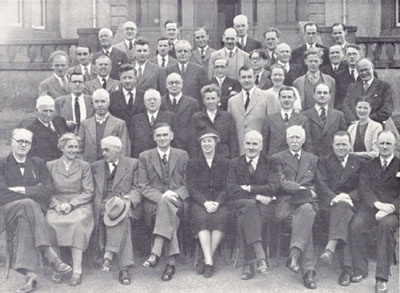
A photograph taken on the steps of the Bruce Hostel, Lerwick.
FRONT ROW – left to right:– Professor Dag Strömbäck; Mrs. Strömbäck; Professor Haakon Shetelig; Principal T.M. Taylor; Mrs. Taylor; General Sir Ronald Adam; Dr. A.O. Curle; Professor Einar Ól. Sveinsson; Mr.T.M.Y. Manson. SECOND AND THIRD ROWS, left to right:– Mr. G.W. Russell; Dr. O. Widding, Jutland; Dr. Per Thorsen, Bergen; Professor Jón Helgason; Dr. Oscar Lundberg; Professor J.D. Mackie; Miss Asa Sjödin; Mr. Haakon Hamre; Dr. A.B. Taylor; Mr. Stewart Cruden; Mrs. Murison.
FOURTH AND FIFTH ROWS, left to right:– Mr. George Scott Moncrieff; Dr. W.T.H. Williamson; Mr. A.C. Davis; professor Angus McIntosh; Dr. Gösta Berg; Mr. H. Harvey Wood; Mr. E.O.G. Turville-Petre; Miss M. Macgregor; Mr. Gerrie; Dr. E.F. Halvorsen; Dr. W. Douglas Simpson.
SIXTH AND SEVENTH ROWS, left to right:– Mr. E.S. Reid Tait; Professor Croft Dickinson; Mr. David Murison; Mr. A.O. O’Dell; Dr. F.T. Wainwright; Professor A.S.C. Ross; Dr. S.H. Delargy; Dr. Christian Matras; Dr. Ragnar Knudsen; Mr. R.W. Munro; Mr. John Stewart; Mr. Erik Frykman.
Contents:
| INTRODUCTION | IX |
| MEMBERS OF CONGRESS | XV |
| PROGRAMME OF MEETINGS | XVII |
THE VIKING CONGRESS IN LERWICK, JULY 1950. Haakon Shetelig, translated by Inge Holbek | XXI |
| THE SHETLAND ISLANDS. A. C. O’Dell | 1 |
| JARLSHOF. A. O. Curle | 9 |
| THE BROCH OF CLICKHIMIN. W. Douglas Simpson | 19 |
THE DATE AND PURPOSE OF THE BROCHS. B. H. St. J. O’Neil | 46 |
| A NOTE ON THE STRUCTURAL FEATURES OF THE BROCHS. Angus Graham | 53 |
HISTORICAL PROBLEMS OF SHETLAND TO THE END OF THE OLD EARLDOM. T. M. Y. Manson | 58 |
| UDAL LAW AND GOVERNMENT IN SHETLAND. John Stewart | 84 |
| SHETLAND PLACE-NAMES IN THE SAGAS. A. B. Taylor | 112 |
| THE VIKING MOVEMENTS. Haakon Shetelig | 130 |
| ODAL RIGHTS AND FEUDAL WRONGS. William Croft Dickinson | 142 |
SHETLAND FOLK TALES. John Nicolson | 161 |
THE CASTLES OF SHETLAND. W. Douglas Simpson | 175 |
NEOLITHIC TEMPLE, STANYDALE, PARISH OF SANDSTING, SHETLAND. Charles S. T. Calder | 184 |
THE NORSE IN THE HEBRIDES. Sir Lindsay Scott. | 189 |
| SOILS AND HISTORY. W. T. H. Williamson | 216 |
ON THE SHETLAND SEA LANGUAGE AS A SOURCE OF OLD NORSE LITERATURE Oskar Lundberg | 221 |
| THE THIRD NORN DIALECT―THAT OF CAITHNESS. Per Thorsen | 230 |
VIKING MILITARY ORGANIZATION AND THE DANISH TRÆLLEBORGS. Ragnar Knudsen | 239 |
| SCOTS SPEECH IN SHETLAND. David Murison | 255 |
ORKNEY-SHETLAND-ICELAND. Einar Ól. Sveinsson | 261 |
ST. MAGNUS CATHEDRAL. Hugh Marwick | 284 |
| MAESHOWE. Hugh Marwick | 286 |
SKARABRAE. Hugh Marwick | 288 |
| THE SHETLAND BOAT. Charles and Duncan Sandison | 291 |